

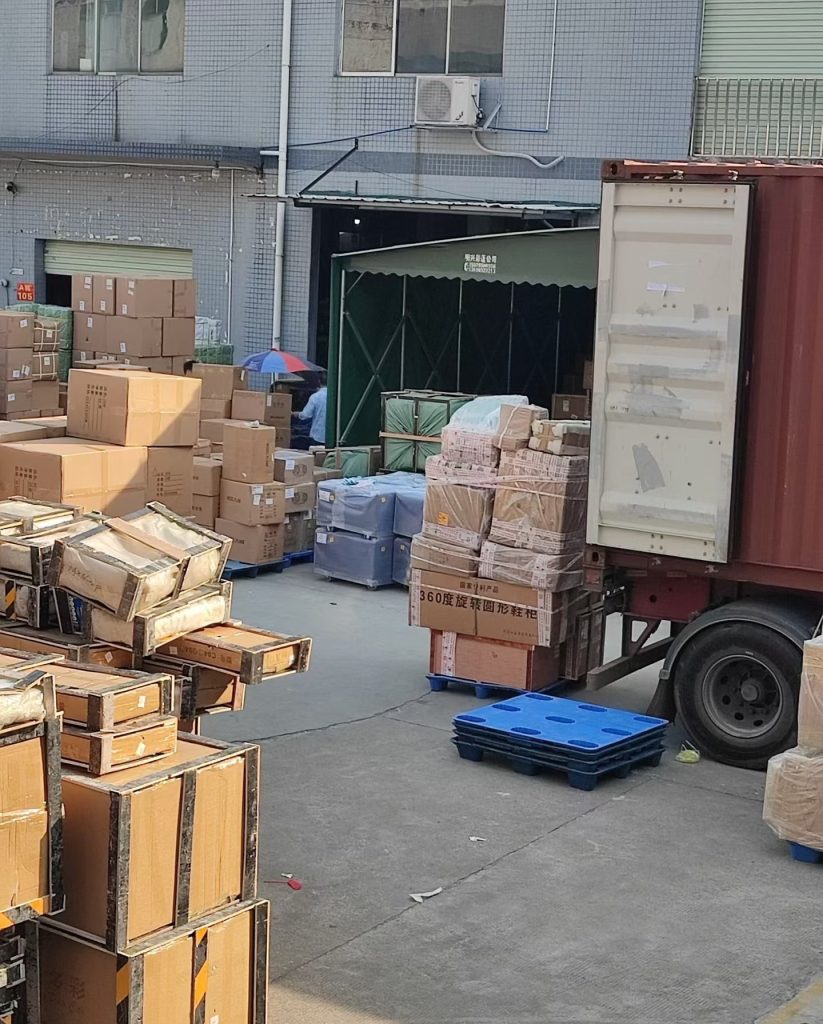
For small and medium-sized exporters shipping from China to Jordan, booking a full container is rarely economical. Most shipments fall into the 1–15 CBM range — too large for express courier, too small for FCL. This is exactly where the China → Aqaba LCL (Less than Container Load) consolidation line earns its place as the default logistics choice for SMEs entering the Jordanian market.
This article provides a detailed, ground-level overview of how the Aqaba LCL service actually works in 2026 — pricing structures, transit times, the true cost stack, compliance pitfalls, and why “1 CBM minimum” is more than just a marketing number.
1. Why Aqaba LCL Is the SME Default
Jordan’s only seaport is Aqaba on the Red Sea, which handles the vast majority of the country’s imports. For SMEs — especially e-commerce sellers, boutique importers, and first-time exporters — the economics are clear:
| Shipment Size | Best Mode | Why |
|---|---|---|
| < 0.5 CBM / < 100 kg | Express courier | Simpler, 3–5 days, but ~USD 8–12/kg |
| 1–15 CBM | LCL sea freight | Best cost-to-time ratio; 1 CBM minimum |
| 15+ CBM | FCL 20′ | Crosses the threshold where FCL beats LCL per-unit |
| > 18 CBM | FCL 40′ HQ | Best USD/CBM ratio |
The 1 CBM minimum is the industry standard on the China–Aqaba lane. Multiple Shenzhen-based freight forwarders publish explicit “1 CBM 起运” (minimum 1 CBM) consolidation services to Aqaba, with weekly sailings and direct consolidation (直拼) via carriers such as HK-APL, WHL, COSCO, ONE, and MSC .
💡 For a small shipment, LCL at USD 50–150 per CBM is roughly 10–20% of the cost of air freight (USD 4–8/kg) and far more manageable than booking a full 20′ container (USD 1,000–3,000) .
2. LCL Service Parameters: What the Market Actually Offers
Based on live 2026 rate filings from Shenzhen forwarders serving the Aqaba lane:
🔹 Core Service Parameters (Shenzhen → Aqaba)
| Parameter | Specification |
|---|---|
| Minimum chargeable volume | 1 CBM |
| Optimal volume range | 0–15 CBM (above 15 CBM, FCL becomes competitive) |
| Transit time | 27–30 days (Shenzhen origin) ; 25–27 days (Shantou origin) ; 27 days (Chongqing via HK-WHL) |
| Carriers | HK-APL, WHL, COSCO, ONE, MSC, ESL |
| Sailing frequency | Weekly — cut-off patterns such as “一截六开” (Mon cut-off, Sat sailing), “二截天开” (Tue cut-off, Sun sailing), “三截天开” (Wed cut-off, Sun sailing) |
| Volume-to-weight ratio | 1 CBM : 500 KG or 1 CBM : 1000 KG (whichever yields higher chargeable volume) |
| Service type | Direct consolidation (直拼) — no secondary consolidation at transshipment hub |
🔹 Indicative LCL Rates by Origin Port (2026)
| Origin | 0–3 CBM | 3–15 CBM | Transit | Carrier |
|---|---|---|---|---|
| Shenzhen | USD 5–12/CBM | USD 9–14/CBM | 27–30 days | HK-APL, WHL, COSCO, ONE, MSC |
| Shantou | USD 10/CBM (0–1 CBM) | USD 20–30/CBM | 25 days | APL |
| Chongqing | USD 10/CBM | USD 9/CBM | 27 days | HK-WHL |
| Xi’an | USD 4/CBM | — | 27 days | WHL |
| Shanghai | — | USD 14/CBM | 27 days | WHL |
| Dongguan | USD 10/CBM | — | 22 days | Subject to carrier |
*Sources: Shenzhen Longg 2026 rate filings ; GoodHope 2026 pricing table ; Wutong 2026 Dongguan rates ; Jiuwen 2026 Shenzhen ESL quote: LCL at USD 50/CBM, ~30 days transit *.
📌 Note on pricing: Rates fluctuate with peak season, Red Sea routing conditions, and carrier capacity. The figures above are reference points — a binding quote must be confirmed at time of booking.
3. The True Cost Stack: Origin Charges + Ocean Freight + Destination Charges
Many first-time LCL shippers make the mistake of looking only at the ocean freight rate. The complete cost stack has three layers:
🔹 Layer 1: Origin Charges (China side — paid in RMB/USD at booking)
From a typical Shenzhen → Aqaba LCL shipment :
| Charge Item | Amount | Notes |
|---|---|---|
| Ocean freight | USD 5–12/CBM | Varies by volume tier |
| Customs declaration fee | RMB 320/BL | Mandatory export clearance |
| Documentation fee (B/L) | RMB 300–350/BL | Bill of Lading issuance |
| CFS / LCL handling fee | RMB 40/CBM or RMB 70/RT | Warehouse loading, consolidation |
| Entry/storage fee | RMB 130/BL | Port handling |
| ENS (Entry Summary Declaration) | USD 25/BL | Required for some carriers |
| Collection fee (if destination charges collect) | USD 20/BL | Only if destination charges are paid on collect basis |
| Cargo insurance | 0.1% of cargo value (min RMB 100) | Optional but strongly recommended |
| Factory pickup | Free for 8+ CBM; otherwise actual cost | From Shenzhen/Dongguan/Foshan/Guangzhou/Shantou/Zhongshan |
🔹 Layer 2: Ocean Freight (USD/CBM)
As per the rate tables above — the dominant cost component.
🔹 Layer 3: Destination Charges (Aqaba side — paid in USD or JOD)
Destination charges are NOT included in the ocean freight quote. They typically include:
- Terminal handling charge (THC) at Aqaba
- Deconsolidation fee (CFS out)
- Delivery order (D/O) fee
- Jordan customs clearance fee
- JSMO inspection fee (if triggered: USD 80–250 for electronics, textiles, etc.)
- Inland trucking (if door delivery requested): Aqaba → Amman ~USD 600–800
⚠️ Critical: Always request a full cost breakdown — origin + ocean + destination — before booking. Forwarders who quote only “USD X/CBM” without disclosing destination charges are setting you up for surprise invoices at Aqaba.
🔹 Layer 4: Jordan Import Duties & Taxes (under DDP or if consignee pays)
If the shipment is under DDP terms, the forwarder pays these on your behalf. Otherwise, the Jordanian consignee settles:
- Customs Duty: 0–30%+ depending on HS code
- GST: 16% on (CIF + duty) — Jordan has no VAT
- Qualitative Tax: 7–45% on electrical appliances and some consumer electronics
- ASEZA exemption: Goods staying within the Aqaba Special Economic Zone are duty-free and GST-zero
4. How the LCL Process Works: Step-by-Step
Phase 1: Booking & Documentation (Days 1–3)
- Booking submission to forwarder: cargo description, HS code (6-digit minimum, 4-digit displayed on B/L per Jordan Customs requirement ), gross weight, volume, package count, supplier address
- Cut-off alignment: match cargo readiness to weekly sailing schedule (e.g., Monday cut-off for Saturday sailing)
- Warehouse appointment: cargo delivered to forwarder’s bonded warehouse in Shenzhen / Guangzhou / Dongguan / Shantou
Phase 2: Origin Handling (Days 3–5)
- Export customs declaration filed with Chinese Customs
- Container loading at CFS — photographic evidence, lashing, weight distribution
- B/L issuance with per-item HS codes (Jordan Customs mandates 4-digit HS code display per product line on the B/L )
- Vessel loading at Shenzhen/Yantian/Shekou
Phase 3: Main Carriage (Days 5–30)
- Transit: Shenzhen → (transshipment at Jebel Ali / direct feeder) → Aqaba, 27–30 days
- Real-time tracking via forwarder’s platform
Phase 4: Aqaba Arrival & Clearance (Days 30–34)
- Arrival notice sent to consignee or forwarder’s Jordanian agent
- ASYCUDA declaration filed by authorized Jordanian customs broker
- Document verification: Commercial Invoice (with Arabic translation), Packing List, B/L, Certificate of Origin
- Duty & tax assessment: based on HS classification
- Physical inspection (if selected): random or risk-based targeting
- JSMO conformity check for regulated products
- Duty & tax payment (by consignee under CNF/FOB, or by forwarder under DDP)
Phase 5: Delivery (Days 34–37)
- Deconsolidation at Aqaba CFS
- Inland trucking to final destination (Amman, Zarqa, Irbid, or within ASEZA)
- Proof of delivery — signed POD returned to forwarder
Total door-to-port transit: 27–30 days. Total door-to-door (with clearance + trucking): 30–35 days.
5. Compliance Pitfalls: What Gets SMEs in Trouble
🔹 HS Code Accuracy Is Non-Negotiable
Jordan Customs requires 4-digit HS codes displayed per product line on the Bill of Lading . Misclassification can result in:
- Penalties for under-declaration
- 10–20% landed cost swing between correct and incorrect HS code
- Clearance delays of 5–10 days while re-classification is processed
- Seizure risk for regulated categories (electronics, telecom, pharmaceuticals)
🔹 B/L Data Must Match Invoice Exactly
Jordanian customs officers perform document verification — they cross-check:
- Product description consistency across B/L, Invoice, Packing List
- HS code accuracy
- Declared value reasonableness (under-valuation triggers audit)
- Origin country (China → standard MFN rates; no China–Jordan FTA exists)
🔹 Certificate of Origin Requirements
- Standard shipments: Chamber of Commerce certified COO
- FTA claims (if goods originate from a country with Jordan FTA — US, EU, UAE): COO must be legalized at the Jordan Embassy in the exporting country before shipment. Retrospective legalization is not accepted
- Arabic translation: All customs-facing documents require Arabic translation
🔹 Product-Specific Permits
| Product | Additional Requirement |
|---|---|
| Electronics / electrical goods | JSMO conformity documentation |
| Telecom / wireless devices | TRC Type Approval + ILAC-MRA accredited lab test reports |
| Pharmaceuticals | JFDA registration + local license holder + (if controlled) MOH permit |
| Food / cosmetics | JFDA registration, health certificate, Halal cert (for meat) |
| Used machinery | Ministry of Industry & Trade special import license |
| Dangerous goods | IMDG Code classification, MSDS, 72-hour advance port authority filing |
| Wooden packaging | IPPC fumigation certificate |
🔹 The “Straight B/L” Trap
Under Jordanian customs practice, if the B/L is made “straight” (non-negotiable, consignee named), the cargo can be released upon presentation of the original B/L and identification. SMEs should always use an “order B/L” (negotiable) to retain control of cargo until payment is secured.
6. Red Sea Routing: 2026 Realities & Buffer Planning
The Red Sea corridor faces ongoing security challenges. According to industry reporting in 2026:
- Approximately 80% of Jordan’s Asian imports transit via Bab el-Mandeb
- Alternative routing via Cape of Good Hope adds 7–15 days to transit
- Some carriers maintain partial direct sailings to Aqaba (e.g., Guangzhou Nansha → Aqaba direct at 14 days) but with very scarce space
- War risk surcharges range USD 2,000–3,000 per container on FCL; LCL surcharges applied proportionally
However, Aqaba Port operations remain officially stable. Jordan’s Ministry of Transport and the Association of Owners of Clearance and Transport Companies confirmed in March 2026 that port operations are running normally, though they warn of potential cost increases due to regional instability .
Practical Implications for LCL Shippers:
- Build 7–10 days of buffer into your delivery timeline for 2026 shipments
- Expect rate volatility — lock quotes with 14-day validity
- Ask your forwarder: “What is the current routing — direct via Bab el-Mandeb or diverted via Cape of Good Hope?”
- Consider transshipment via Jebel Ali: Nearly 80% of Asian cargo to Jordan now routes through Jebel Ali, Khorfakkan, or Port Said before feeder to Aqaba
- Peak season (July–October): Book 3–4 weeks in advance to secure space
7. DDP Option for LCL: When SMEs Should Upgrade
While standard LCL is CIF Aqaba (buyer handles clearance), SMEs without a Jordanian importer of record should strongly consider LCL + DDP:
| Factor | Standard LCL (CIF) | LCL + DDP |
|---|---|---|
| Who clears customs? | Jordanian consignee | Forwarder’s local agent |
| Who pays duty/GST? | Consignee | Forwarder |
| Local presence required? | Yes — importer of record | No |
| Cost predictability | Variable — surprise charges possible | Fixed all-inclusive quote |
| Best for | Experienced importers with local broker | First-time exporters, e-commerce sellers |
| Typical surcharge | — | +30–50% on ocean freight (covers duty estimate, clearance, trucking) |
💡 Rule of thumb: If you’re a Chinese SME selling to a Jordanian buyer who lacks import infrastructure, DDP is not optional — it’s the only viable model. The buyer gets a predictable landed cost; you retain control of the supply chain.
8. Choosing the Right Forwarder for Aqaba LCL
✅ Must-Have Capabilities
- Proven Aqaba LCL consolidation track record (ask for 2025–2026 shipment references)
- Block space agreements with HK-APL, WHL, COSCO, ONE, MSC on the China → Aqaba lane
- Licensed Jordanian clearing partner at Aqaba (not just a correspondent — an actual licensed broker)
- Weekly sailing commitment — published ETD schedule from Shenzhen/Guangzhou/Shanghai
- Transparent quoting — itemized origin charges, ocean freight, destination charges, and DDP estimate
- Bilingual team — Mandarin/Arabic/English
- Real-time tracking platform
⚠️ Red Flags
- Quotes “USD X/CBM all-in” without disclosing destination charges
- Cannot name their Aqaba clearing agent
- No published weekly sailing schedule
- Unwilling to provide HS code-based duty estimation
- Claims “guaranteed direct sailing” without acknowledging Red Sea routing variability
- No cargo insurance option
9. Cost Optimization Tactics for SME LCL Shippers
- Consolidate to cross volume tiers: Many forwarders offer lower per-CBM rates at 3 CBM+ thresholds. Merging two small shipments into one 3.5 CBM shipment often reduces unit cost .
- Ship from the nearest port to your supplier: A Shenzhen supplier → Shenzhen port eliminates domestic trucking. A Guangzhou supplier → Guangzhou/Nansha port is optimal.
- Book 3–4 weeks ahead in peak season (July–October): Last-minute LCL bookings face severe space shortages and PSS (Peak Season Surcharge)
- Optimize packaging density: At 1:1000 ratio (1 CBM = 1000 KG chargeable), lightweight bulky cargo is charged by volume. Reducing a carton’s size by 10% across 20 cartons saves 0.2+ CBM
- Pre-classify HS codes before booking: Work with your forwarder to lock HS classification — this determines duty rate and JSMO trigger
- Leverage ASEZA for warehousing: If you have a Jordanian customer in Aqaba, delivering within ASEZA avoids all duty and GST
- Consider DDP for recurring shipments: Forwarders offer better DDP rates for committed monthly volume
- Avoid Thursday arrivals: Jordan’s weekend is Friday–Saturday. Containers arriving Thursday often sit until Sunday, incurring 3+ days of storage
10. The Bottom Line: Why LCL Is the SME Gateway to Jordan
For small and medium exporters, the China → Aqaba LCL line with its 1 CBM minimum offers:
- ✅ Affordability: 50–150 USD/CBM vs. thousands for FCL or per-kg for air
- ✅ Accessibility: Weekly sailings from Shenzhen, Guangzhou, Shanghai, Ningbo, Qingdao, Chongqing, Xi’an, Shantou
- ✅ Flexibility: Ship 1 CBM or 15 CBM on the same consolidation
- ✅ Predictability: 27–30 days transit under normal routing
- ✅ Manageability: DDP upgrade path removes compliance burden
- ✅ Scalability: As volume grows past 15 CBM, transition seamlessly to FCL
The key to success is partnering with a forwarder who specializes in the China–Aqaba lane, understands Jordanian customs nuances, maintains genuine block space with carriers, and operates a licensed clearing agent at Aqaba. The difference between a smooth LCL experience and a logistical nightmare is not the ocean freight rate — it’s the forwarder’s local Jordanian capability and transparency in quoting.
⚠️ Reality check for 2026: Red Sea routing conditions introduce genuine transit variability. A forwarder who promises you a fixed “27 days, guaranteed” without acknowledging routing options is either naive or misleading. Demand transparency: “What is your current routing? What is the realistic transit window? What happens if the vessel diverts via Cape of Good Hope?”
Ready to ship your first LCL to Aqaba? Provide your cargo details — product description, HS code, volume (CBM), weight (KG), supplier location in China, and destination in Jordan. A specialist Aqaba LCL desk will respond within 24 hours with a transparent, itemized quote covering origin charges, ocean freight, estimated destination charges, and optional DDP upgrade — all anchored to the upcoming weekly sailing schedule.